


.png)
Luxembourg-based R3 Robotics, a pioneer in advanced robotics for sustainable manufacturing, announced on February 13, 2026, the successful closure of a €20 million funding round aimed at scaling its groundbreaking AI-powered disassembly technology for electric vehicle (EV) systems. This investment comprises €14 million in Series A equity financing from leading European venture capital firms specializing in deep tech and cleantech, alongside €6 million in non-dilutive public grants from Luxembourg and EU innovation funds focused on circular economy initiatives. The funding will enable R3 Robotics to transition from pilot deployments to full industrial-scale production, addressing the surging demand for efficient recycling of EV batteries as Europe accelerates its transition to electric mobility.
The core technology at the heart of R3's platform is an autonomous robotic system designed specifically for the disassembly of end-of-life EV batteries, motors, drives, and associated powertrain components. Traditional manual disassembly methods are labor-intensive, hazardous due to chemical and fire risks, and inefficient for the high volumes expected from the EU's ambitious EV adoption targets. R3's solution leverages artificial intelligence, machine vision, and adaptive robotics to perform precise, high-speed dismantling with near-zero error rates. The system identifies and separates critical materials such as lithium, cobalt, nickel, and rare earth elements, enabling high-purity recycling streams that feed back into new battery production. This aligns perfectly with EU regulatory mandates under the Battery Regulation (EU) 2023/1542, which requires 80% recyclability of lithium-based batteries by 2031.
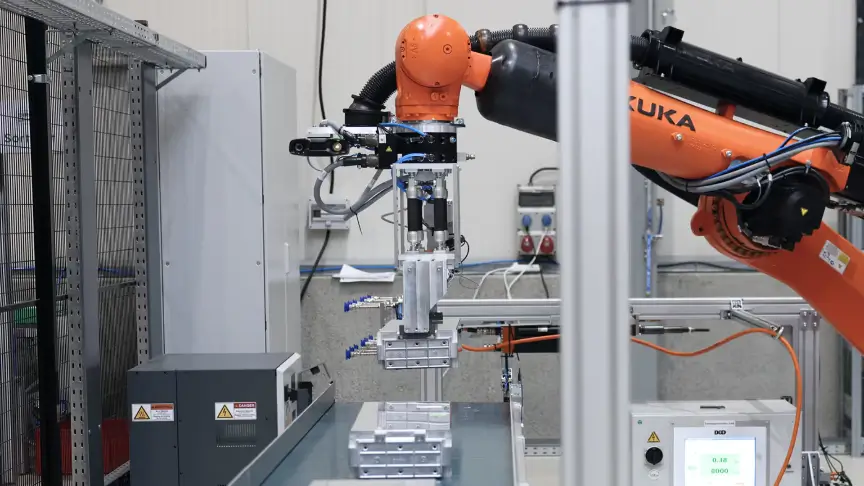
Europe's industrial automation sector is witnessing a paradigm shift towards circular economy models, particularly in the **Electronics, Semiconductors, Electrical Components** and **Motors, Drives, Actuators** categories. R3 Robotics' platform represents a key advancement in **Integrated Processes and IT solutions**, integrating AI-driven **Search Detection & Auto Regulating Systems** for real-time adaptation to varying battery chemistries and degradation states. Initial pilots conducted with major OEMs in Germany and France have demonstrated a 5x increase in throughput compared to manual processes, reducing disassembly time from hours to minutes per module. Energy consumption is optimized through predictive algorithms that minimize robotic movements, contributing to lower operational costs and a reduced carbon footprint.
The funding round was oversubscribed, reflecting strong investor confidence in R3's technology amid Europe's push for strategic autonomy in critical raw materials. Key investors include the European Investment Fund (EIF), which provided €5 million through its Cleantech Innovation Platform, and private VCs such as High-Tech Gründerfonds and Luxembourg Future Fund. Public grants stem from the Horizon Europe program and national incentives under Luxembourg's Smart Industry initiative. These resources will fund the construction of a flagship manufacturing facility in Luxembourg's Belval innovation campus, set to commence operations by Q4 2026 with an initial capacity of 50,000 EV battery packs annually.
Strategic partnerships are a cornerstone of R3's expansion. The company has signed MOUs with leading battery recyclers like Umicore and Northvolt, as well as automakers including Volkswagen Group and Stellantis, for co-development and large-scale deployment. These collaborations will integrate R3's systems into existing reverse logistics networks, ensuring seamless handling from vehicle end-of-life collection to material re-refining. In terms of **Industrial R&D**, R3 is investing €8 million from the funding into next-generation features, including dual-arm robotic manipulators for complex motor and inverter disassembly, and blockchain-tracked material passports for compliance with EU Digital Product Passport requirements.
Market projections underscore the timeliness of this scaling. The EU expects over 20 million end-of-life EVs by 2030, generating 1.5 million tons of battery waste annually. Current recycling capacity lags far behind, with less than 50% of batteries properly processed. R3's solution not only bridges this gap but also creates high-value secondary materials, potentially reducing Europe's reliance on imports by 30%. Facility managers and system integrators in the automotive supply chain stand to benefit from modular deployment options, allowing integration into brownfield sites without major retrofits.
Cybersecurity is embedded from the ground up, with AI models trained on edge computing to prevent data leaks in sensitive manufacturing environments. Energy efficiency aligns with **Power Generation, Distribution** standards, utilizing regenerative braking in robotic arms to recapture up to 15% of operational power. As Europe grapples with energy constraints for AI and electrification, R3's low-power footprint positions it as a model for sustainable automation.
CEO Maria Gonzalez commented, "This funding validates our vision of robotics as the enabler of Europe's circular battery economy. We're not just disassembling vehicles; we're rebuilding supply chain resilience." Industry analysts predict R3 could capture 15% market share in EU EV disassembly by 2028, driving job creation in high-skill automation roles.
%20(2).png)
%20(22).png)
%20(20).png)
%20(19).png)
%20(18).png)
%20(2).png)
%20(4).png)
%20(5).png)
%20(10).png)
.png)
%20(1).png)
%20(10).png)
%20(8).png)
%20(7).png)
%20(2).png)
.png)
%20(1).jpg)
%20(6).png)
%20(5).png)
%20(4).png)
%20(3).png)
%20(1).png)
.png)



.png)

%20(1).png)
.png)
.png)
%20(2).png)
.png)

.png)


